
Beyond the Exhibit Board: How AR, 3D-Printed Evidence, and Trial Tech Are Changing What Juries See
Beyond the Exhibit Board: How AR, 3D-Printed Evidence, and Trial Tech Are Changing What Juries See
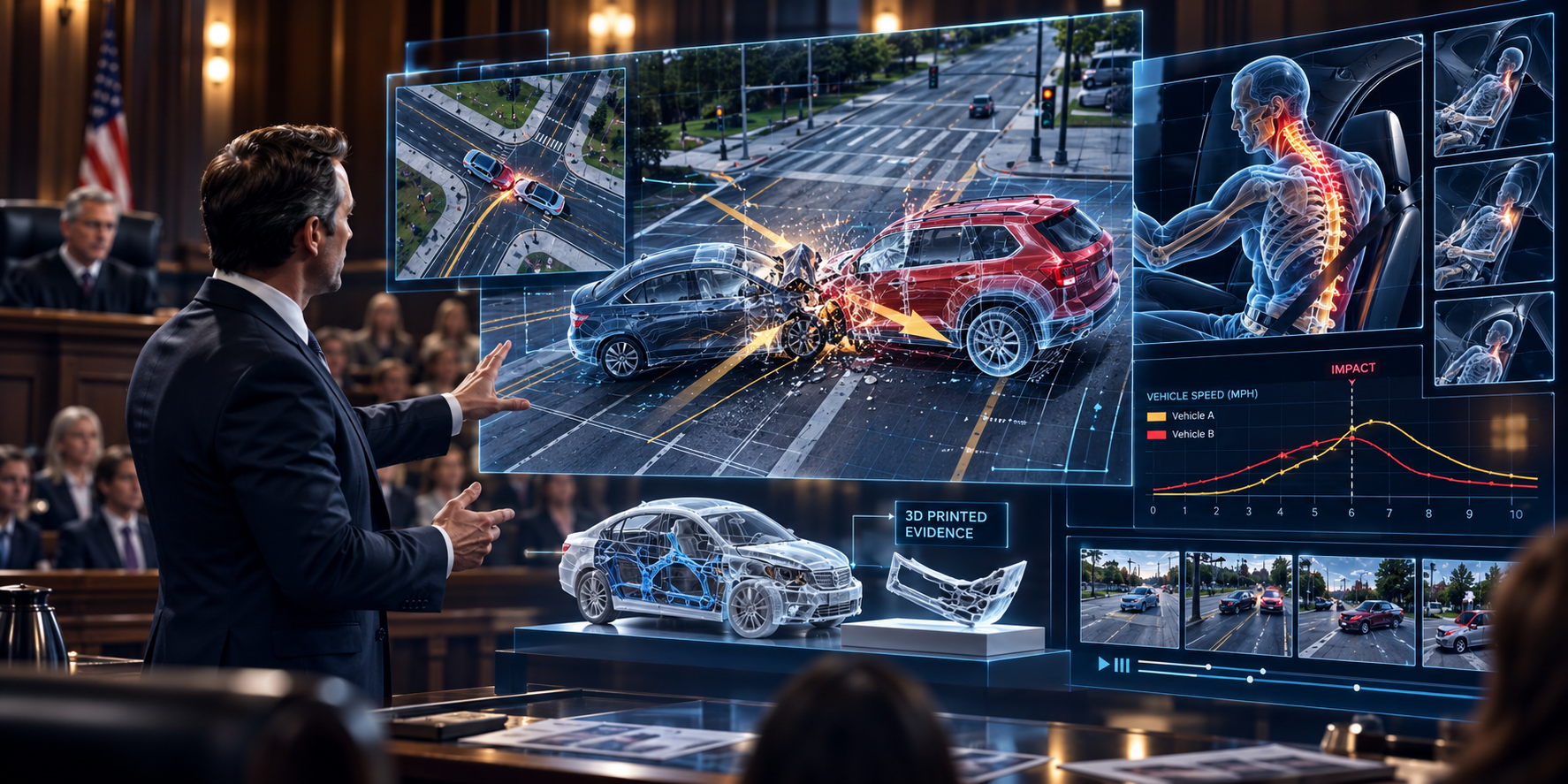
For decades, "demonstrative evidence" meant a foam board, a PowerPoint slide, maybe a looped animation on a courtroom monitor. That's still useful — but it's no longer the ceiling. Litigation teams now have access to augmented reality models a juror can view on a phone, physical 3D-printed replicas of an actual CT scan, and enhanced video/audio evidence clarified well past what the original recording offered. None of this is gimmick technology. Used correctly, it's some of the most persuasive — and most underused — litigation support available.
Why "New" Doesn't Mean "Flashy"
There's a real risk with newer courtroom technology: teams reach for it because it's impressive, not because it's the right tool for the fact pattern. The standard should stay the same as it is for any demonstrative — does this make a true fact easier to understand, and is it built directly from the evidence? AR, 3D printing, and enhanced media only earn their place in a case when they meet that bar. When they do, they tend to outperform anything static.
Augmented Reality: Evidence a Juror Can Hold in Their Hands
Augmented reality models — built from LiDAR scans and direct medical imaging data — let a juror, mediator, or expert examine an injury or a scene from every angle, at true scale, using nothing more than a phone or tablet. Instead of interpreting a flat photo or a single-angle animation, they can walk around a reconstructed accident scene or rotate a 3D model of a fractured vertebra themselves.
This matters most in depositions and mediation, where a compact, portable, undeniably accurate model can carry more weight than a binder of photographs. It also matters at trial for cases where spatial relationships are the whole argument — how far apart two vehicles really were, whether a hazard was actually visible from where a plaintiff was standing.
3D-Printed CT Scans: Making an Injury Impossible to Abstract
A radiology report describing a "comminuted fracture" is easy for a jury to gloss over. A physical, 3D-printed model of that exact fracture — exported directly from the client's own CT scan data — is not. This is one of the more powerful uses of 3D radiological graphics: turning imaging data most jurors can't read into a physical object they can pick up and examine, shipped ahead of the court date so it's ready when trial starts.
Because these models are exported directly from the client's own scan, they carry an evidentiary credibility that an illustration alone doesn't have — it's not an artist's interpretation, it's the injury itself, rendered at physical scale.
Video and Audio Enhancement: Evidence You Already Have, Just Clearer
Not every piece of persuasive evidence needs to be built from scratch. Surveillance footage, dashcam video, or recorded statements are often already in the file — just low-resolution, poorly lit, or hard to hear. Upscaling video and isolating audio can turn evidence that was previously unusable into something a jury can actually see and hear clearly, without altering what was recorded.
This is frequently the highest-ROI piece of litigation support in a case, precisely because the evidence already exists — the cost is in clarity, not creation.
Trial Tech Services: The Unglamorous Work That Prevents Disasters
None of the above matters if it fails to display correctly in the courtroom. Trial tech services — experienced technicians who also understand design — handle the last-mile work: formatting exhibits for the courtroom's actual display system, making last-minute digital edits between sessions, and troubleshooting on the spot when a judge's schedule changes overnight. It's the least visible part of litigation graphics and often the most important, since a brilliant animation that won't play on the courtroom projector helps no one.
Matching the Tool to the Moment
Litigation Moment
Best-Fit Tool
Expert deposition on a specific injury
Colorized medical illustration or 3D radiological rendering
Mediation session
Interactive case presentation, AR model, or timeline exhibit
Trial — mechanism of injury or collision
Accident reconstruction animation
Trial — expert testimony on physical evidence
3D-printed model or AR experience
Low-quality surveillance or recorded evidence
Video/audio enhancement
Questions Worth Asking a Litigation Graphics Provider
Can AR models and 3D prints be generated directly from our client's actual imaging or scan data?
Is enhanced video/audio work forensically sound enough to withstand a foundation challenge?
Is trial tech support included, or does courtroom setup fall on our own staff?
Is pricing flat-rate across these services, or does newer technology carry hourly premiums?
What's the realistic lead time to have a 3D-printed model shipped before a court date?
The Bottom Line
The tools have changed, but the standard hasn't: every exhibit, whether it's a foam board or an augmented reality model, has to trace back to real evidence and make a true fact easier to grasp. Firms that treat AR, 3D printing, and enhanced media as part of a flat-rate litigation support package — rather than a specialty add-on — end up with a deeper toolkit for both mediation and trial, without the unpredictable costs that used to keep this kind of technology out of reach for anything but the largest cases.
Explore Modern Trial Technology for Your Case
From augmented reality and 3D radiological graphics to enhanced media and courtroom presentation support, the right technology can make complex evidence easier to understand. Trial Template helps legal professionals choose visual solutions suited to their case requirements.
Explore our trial tech services and augmented reality experiences to learn more.