
Flat-Rate Litigation Support: Why More Attorneys Are Switching to Predictable-Cost Trial Demonstratives
Flat-Rate Litigation Support: Why More Attorneys Are Switching to Predictable-Cost Trial Demonstratives
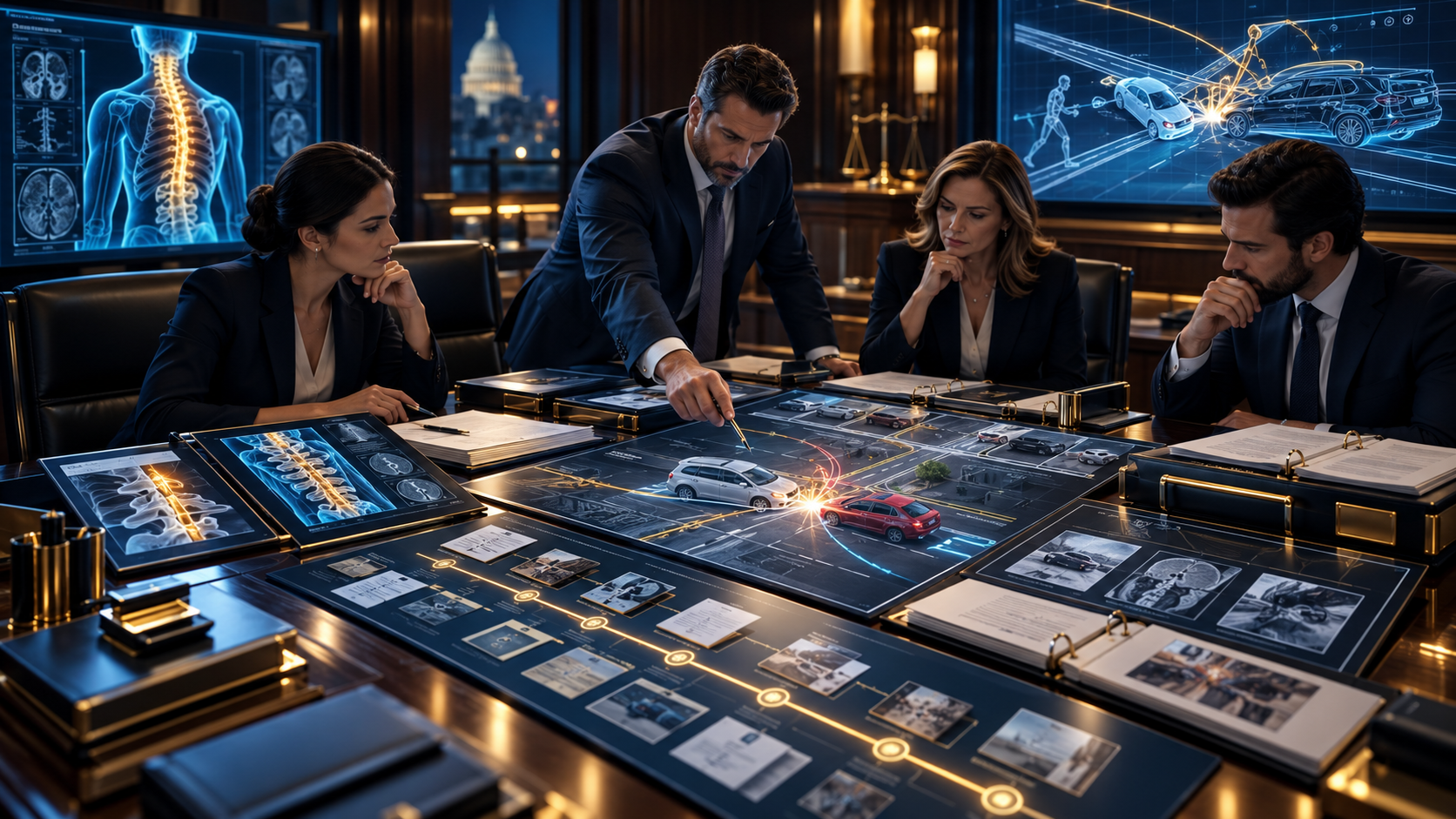
A jury doesn't remember your closing argument word for word. It remembers what it saw. The torn ligament rendered in 3D. The intersection where the collision happened, rebuilt to scale. The timeline that showed, at a glance, how a routine surgery turned into eighteen months of pain. That's the power of a well-built demonstrative — and it's exactly why litigation graphics have gone from "nice to have" to a standard line item in case strategy.
The problem has never been whether demonstratives work. It's been the cost, the timeline, and the guesswork of hiring a vendor without knowing what the final invoice will look like. That's where flat-rate litigation support changes the equation.
What Is Flat-Rate Litigation Support?
Flat-rate litigation support means you know the cost of your trial graphics before the project starts — not after a designer has billed forty hours reworking a medical illustration your expert didn't sign off on. Instead of open-ended hourly billing, a flat-rate model prices the deliverable: the animation, the timeline, the exhibit board, the 3D medical rendering.
For plaintiff's firms working on contingency, this isn't just convenient — it's essential. You can build demonstratives into your case budget from the moment you send a demand letter, without worrying that a complex case will balloon your visual evidence costs past what the case can bear.
Trial Demonstratives That Do More Than Decorate
Demonstrative evidence has one job: make a complicated fact instantly understandable. Medical causation, mechanism of injury, a sequence of corporate decisions that led to a defect — these are hard to argue in words alone and easy to grasp in a well-designed visual.
That's the distinction worth making early: a demonstrative isn't decoration bolted onto your argument. It's part of the argument. The best litigation graphics teams build exhibits the way a trial attorney builds a case — starting with the single fact the jury needs to walk away remembering, then designing backward from there.
Common categories of trial demonstratives include:
Custom graphics — injury diagrams, surgical procedures, premises liability environments, and sequence-of-events boards
Hyperlinked timelines — chronologies that link directly to medical records, exhibits, and evidence so opposing counsel and the jury can follow the injury's real-world impact
Interactive case presentations — full visual narratives that frame damages and exposure for mediation or trial
3D radiological graphics — CT and MRI data rendered into video, imagery, or even 3D-printed physical models
Animations for Trial: Making the Invisible Visible
Some facts simply can't be photographed. Nobody has video of the exact moment a herniated disc pinched a nerve, or the precise sequence of two vehicles colliding at an unmarked intersection. That's where animations for trial earn their keep.
A well-produced 2D or 3D animation reconstructs the mechanism of injury, the surgical procedure, or the collision sequence using the underlying evidence — scene measurements, medical imaging, engineering data — rather than dramatization. Done properly, an accident reconstruction animation doesn't editorialize; it demonstrates what the physical evidence already supports, frame by frame, so a jury can watch cause and effect instead of imagining it from testimony alone.
The same principle applies to surgical and injury animations. Watching a torn rotator cuff repaired, or a spinal fusion performed, gives jurors context no radiology report can. It's the difference between telling a jury someone was hurt and showing them exactly how.
Medical Illustration for Trial: Precision Jurors Can Trust
Medical illustration for trial sits at the intersection of art and accuracy. A colorization overlay on a CT scan can highlight the exact area of injury or pain in a way a raw grayscale scan never will. A static X-ray or MRI paired with an illustrated overlay turns a technical image only a radiologist can read into something a jury understands in seconds.
This matters because credibility is everything in front of a jury. A medical illustration that's even slightly inaccurate can undermine your expert's testimony rather than support it. Illustrations should be built directly from the imaging data and reviewed against the medical record — not generic stock anatomy dressed up to look case-specific.
Demonstrative Evidence and Expert Witness Demonstratives
Your expert witness can testify all day about a biomechanical injury pattern or an engineering failure, but testimony alone asks a jury to hold a lot in their heads at once. Expert witness demonstratives — boards, animations, or interactive exhibits built to accompany testimony — give the jury something to look at while the expert explains, anchoring complex opinions to a clear visual.
The goal with any piece of demonstrative evidence is admissibility and clarity working together. Exhibits built from the actual evidentiary record — not artistic interpretation — hold up better to opposing counsel's objections and carry more weight with the judge and jury alike.
Timeline Exhibits: Turning Records Into a Story
Medical records, discovery documents, and case chronologies are dense. A timeline exhibit for trial compresses months or years of records into a single visual arc a jury can track in seconds — the injury, the treatment, the setbacks, the long-term impact. Hyperlinked timelines take this further, letting attorneys click directly from a point on the timeline to the underlying medical record or exhibit during testimony, without shuffling through binders in front of the jury.
Litigation Graphics for Mediation — Including in Grand Rapids
Trial isn't the only place demonstratives matter. A strong mediation presentation often does more to move a case toward settlement than any brief. Mediators and adjusters respond to the same visual clarity a jury would — a clear timeline, a colorized injury overlay, a short animation showing mechanism of injury can reframe how the other side values a case before it ever gets near a courtroom.
For firms handling mediation in Grand Rapids and across Michigan, having polished, defensible demonstratives ready for the mediation table — not just for trial — is often what separates a fair settlement offer from a lowball one. The same standard of accuracy that would survive cross-examination should be the standard applied at mediation, because a demonstrative that looks rushed undercuts the seriousness of the demand.
Why Flat-Rate Pricing Matters for Litigation Graphics
Hourly billing on complex litigation graphics creates a strange incentive problem: the firm doing the best, most thorough work can end up costing you the most, simply because thoroughness takes time. Flat-rate litigation support removes that tension. You know the investment before you commit, you can plan it against case value from the earliest stages of the file, and revisions don't turn into a second invoice.
For firms handling injury visualization across a full caseload — not just a single bet-the-company trial — predictable pricing on animations, illustrations, and exhibits makes it realistic to use high-quality demonstratives on more cases, not just the largest ones.
Choosing a Litigation Graphics Partner
When evaluating a provider for trial demonstratives, animations, or medical illustration, look for:
Accuracy tied to the record. Every illustration, animation, or 3D model should trace back to medical imaging, scene evidence, or discovery — not generic templates.
Flat-rate or package pricing. You should know the cost before the work begins.
Turnaround built for litigation deadlines. Trial and mediation dates don't move for a designer's schedule.
Range of formats. The right exhibit for a mediation session (a clean static board) isn't always the right exhibit for trial (an interactive presentation or 3D animation) — a good partner offers both.
A team that understands the courtroom, not just the software — people who know what survives a Daubert challenge and what a jury actually absorbs.
Frequently Asked Questions
What does flat-rate litigation support include? It typically covers the design and production of trial demonstratives — animations, medical illustrations, timelines, custom graphics, and interactive presentations — for a set price agreed on before work begins, rather than hourly billing.
Are trial animations admissible as evidence? Courts generally treat accident reconstruction and medical animations as demonstrative evidence rather than substantive evidence, meaning they're used to illustrate testimony. Admissibility depends on the animation being an accurate, evidence-based representation and on your jurisdiction's rules — always vet exhibits with local counsel before trial.
How far in advance should I order trial demonstratives? As early as possible — ideally when you send your demand letter. Complex animations and 3D medical renderings take time to build correctly, and early demonstratives can also strengthen your position at mediation.
Can the same demonstratives be used for both mediation and trial? Often, yes, with adjustments. A mediation presentation may lean more narrative and settlement-focused, while trial exhibits need to withstand objections and cross-examination, so some elements are typically refined between the two. Looking for reliable litigation support for your next case? Visit TrialTemplate to explore our services, or book a consultation with our team to discuss your project