
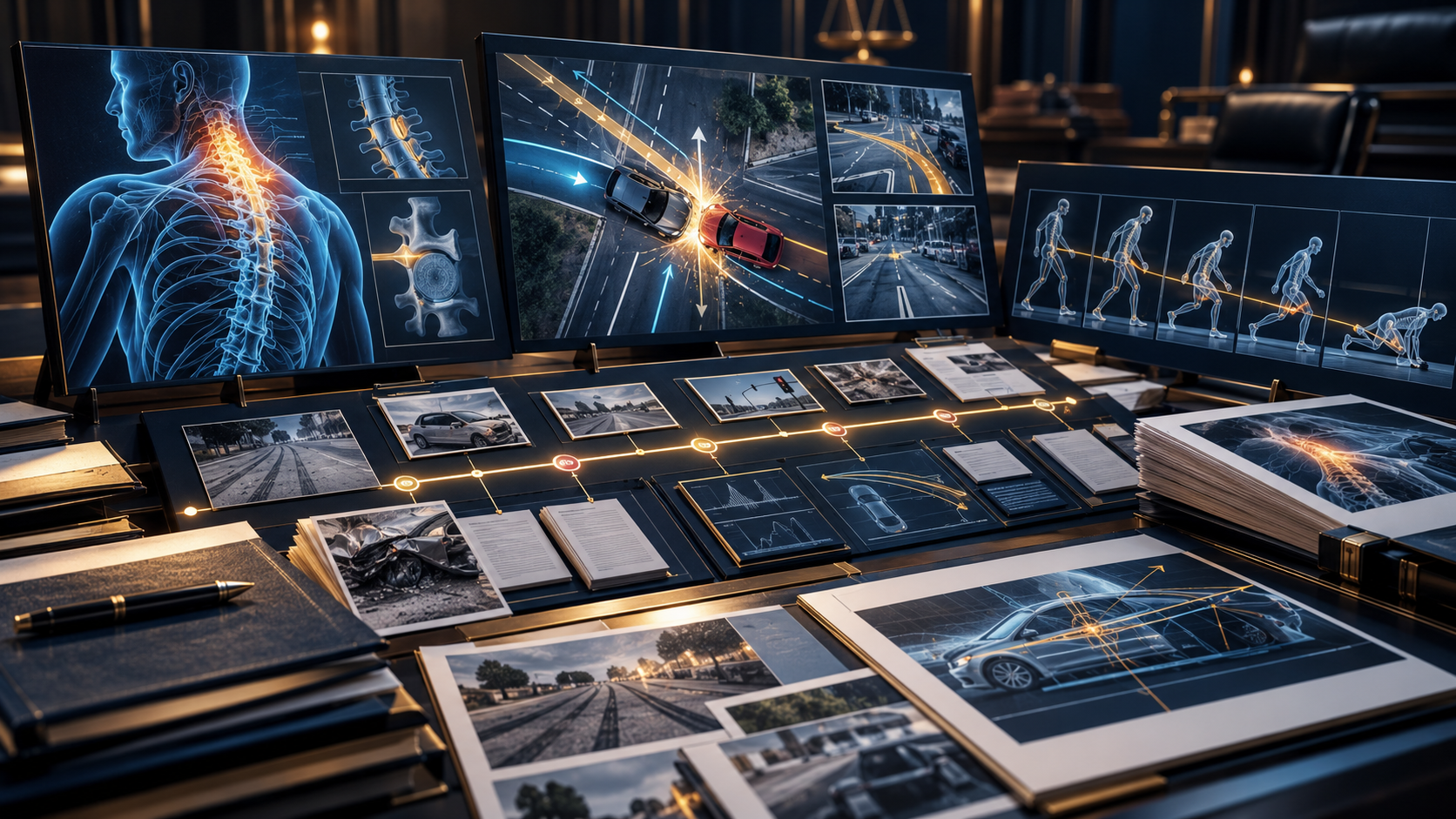
How Litigation Graphics Win Cases: A Practical Guide to Trial Demonstratives
How Litigation Graphics Win Cases: A Practical Guide to Trial Demonstratives
Ask any trial attorney what actually sways a jury and most will tell you the same thing: it's rarely the driest fact in the record. It's the moment the jury sees the injury, watches the collision unfold, or finally understands a medical record they'd otherwise skim past. That's the entire purpose of litigation graphics — and it's why demonstrative evidence has become a core part of case preparation rather than an afterthought before trial.
This guide walks through what demonstrative evidence actually does, the main formats attorneys rely on, and what separates a graphics partner worth hiring from one that just makes things "look nice."
Why Demonstrative Evidence Exists
Jurors aren't medical professionals, engineers, or accident reconstructionists. They're asked to absorb complicated causation arguments in a matter of days, then render a verdict. Demonstrative evidence — diagrams, animations, illustrations, timelines — exists to close that gap between what the record says and what a lay juror can actually understand.
Good trial illustration doesn't simplify a case; it clarifies it. There's a difference. The facts stay exactly as complex as the medicine or the physics demands — the graphic just makes those facts legible at a glance instead of requiring the jury to reconstruct them from testimony alone.
The Core Formats of Trial Graphics
Animations and illustrations for trial generally fall into a few practical categories, each suited to a different kind of fact pattern:
Injury and medical illustration — anatomical diagrams, colorized CT/MRI overlays, and surgical animations that show what happened inside the body, not just what a scan technically records
Accident and incident reconstruction — vehicle collisions, premises liability scenes, and mechanism-of-injury animations built from scene evidence and measurements
Timeline exhibits — chronological boards or hyperlinked digital timelines connecting the injury, treatment, and long-term impact directly to the underlying records
Interactive case presentations — full visual narratives used in mediation or trial to frame damages and exposure
3D and radiological renderings — CT/MRI data converted into 3D video, imagery, or even physical 3D-printed models an expert can hold up in court
Each format solves a different problem. A colorized MRI overlay works for a deposition question about a specific injury; an interactive presentation works for framing an entire case narrative at mediation. Knowing which format fits which moment is part of what a good litigation graphics team brings to the table — it's not one-size-fits-all.
Where Injury Visualization Changes Outcomes
Injury visualization tends to matter most in exactly the cases where words fall short: soft-tissue injuries that don't show up cleanly on imaging, internal injuries invisible to a jury without a rendering, or long-term impact that's hard to convey through medical records alone. A well-built illustration can take a scan only a radiologist can interpret and turn it into something a jury grasps in seconds.
This applies just as much at the mediation table as it does at trial. In markets like Grand Rapids, where mediation often resolves cases well before a courtroom is ever booked, sharp injury visualization at the mediation stage can directly shift how an adjuster or mediator values a claim — sometimes more effectively than the brief itself.
What Makes an Expert Witness Demonstrative Effective
An expert witness demonstrative should do one job: make the expert's opinion easier to follow, not more impressive-looking. The best demonstratives are:
Traceable to the record — built from actual imaging, measurements, or discovery, not stock anatomy or generic templates
Reviewed with the expert before trial, so the visual matches the testimony exactly
Simple enough to explain in one sentence, even if the underlying science is complex
Durable under cross-examination — able to withstand questions about how it was built and what data supports it
A flashy animation that an expert can't fully defend on the stand does more harm than good. Accuracy always outranks polish.
The Case for Flat-Rate Litigation Support
Litigation graphics have historically been billed by the hour, which creates an awkward reality: the more thorough the work, the higher the invoice — even when that thoroughness is exactly what makes an exhibit defensible. Flat-rate litigation support flips that incentive. The price is set against the deliverable, not the clock, so firms can budget demonstratives into a case from the start — often as early as the demand letter — without an open-ended cost hanging over the file.
For firms running a full caseload rather than a single high-value trial, that predictability is often what makes it realistic to use professional-grade graphics across more cases, not just the biggest ones.
Questions to Ask Before Hiring a Litigation Graphics Team
Is pricing flat-rate or hourly, and is it quoted before work begins?
Can they show examples of medical illustration, animation, and timeline work specific to case types like yours?
Do they build exhibits directly from medical imaging and case evidence, or from generic templates?
Can they turn around work on litigation timelines, including short-notice mediation dates?
Do they offer both mediation-focused presentations and trial-ready exhibits — since the two aren't always interchangeable?
The Bottom Line
Demonstrative evidence isn't about making a case look dramatic — it's about making a true, complex set of facts understandable to people who are seeing it for the first time. Whether it's a colorized injury overlay, an accident reconstruction animation, or a hyperlinked timeline, the exhibits that perform best are the ones built directly from the evidentiary record, priced predictably, and designed with the courtroom — not just the screen — in mind.